Search is changing.
People still use traditional search engines such as Google and Bing, but they increasingly discover information through AI-powered search experiences, answer engines, assistants, and generative search systems.
This change has introduced terms such as AI SEO, Answer Engine Optimization (AEO), and Generative Engine Optimization (GEO).
It has also increased interest in a relatively new website file called llms.txt.
But what exactly is llms.txt? Does it improve SEO? Can it help ChatGPT, AI agents, or other large language models understand your website? And should website owners create one?
This guide explains what llms.txt is, how it works, where it fits alongside SEO, AEO and GEO, and how website owners can prepare their content for the future of search.
What Is llms.txt?
llms.txt is a proposed Markdown-based file designed to give AI systems and agents a concise, structured overview of a website and links to its most useful content.
It is usually placed at:
example.com/llms.txt
The proposal was introduced by Jeremy Howard in 2024 and updated to version 2 in August 2026. The specification describes llms.txt as a way of giving AI agents cleaner, easier-to-process information than they might receive from a complex HTML webpage.
You can review the original llms.txt specification for its current recommended structure.
Quick answer
Does llms.txt improve Google rankings?
No direct ranking benefit has been established. In fact, Google currently states that it does not use llms.txt as a special signal for Google Search or its generative AI features. Google says creating one will neither improve nor hurt Google Search rankings.
However, llms.txt may still be useful for other AI agents, applications, documentation systems, crawlers, or services that choose to support the convention.
That distinction is important.
llms.txt should complement your SEO strategy, not replace it.
How Does llms.txt Work?
Traditional web pages are built primarily for humans.
A webpage may contain:
- Navigation
- JavaScript
- Advertisements
- Sidebars
- Cookie banners
- Images
- Interactive elements
- Footer links
- Tracking scripts
- Dynamic content
A language model or AI agent often needs the actual information hidden among all those elements.
The idea behind llms.txt is to provide a cleaner map.
Instead of forcing an AI system to interpret an entire website, the file can identify the site's purpose and point toward important resources.
A simplified example might look like this:
# Example Website

> A collection of SEO and website optimization tools for marketers,
developers and website owners.

## SEO Tools

- SEO Audit Tool: Analyze website SEO and technical issues.
- Meta Tag Generator: Generate SEO metadata.
- Sitemap Generator: Create XML sitemaps.

## Guides

- Technical SEO Guide
- Internal Linking Guide
- AI Search Optimization Guide
The official specification uses Markdown because it is readable by both humans and machine-processing systems.
llms.txt vs robots.txt vs XML Sitemap
These files solve different problems and should not be confused.
robots.txt
A robots.txt file gives compliant crawlers instructions about which parts of a website they may or may not crawl.
Website owners can create crawl directives using the WaooTools Robots.txt Generator.
XML Sitemap
An XML sitemap helps search engines discover important URLs on a website.
Its primary purpose is URL discovery rather than explaining the meaning of the website.
llms.txt
llms.txt attempts to provide context and important resources specifically in a format that AI systems and agents can process efficiently.
In simple terms:
robots.txt = crawling instructions
XML sitemap = important URL discovery
llms.txt = structured context and resources for compatible AI systems
One file does not replace the others.
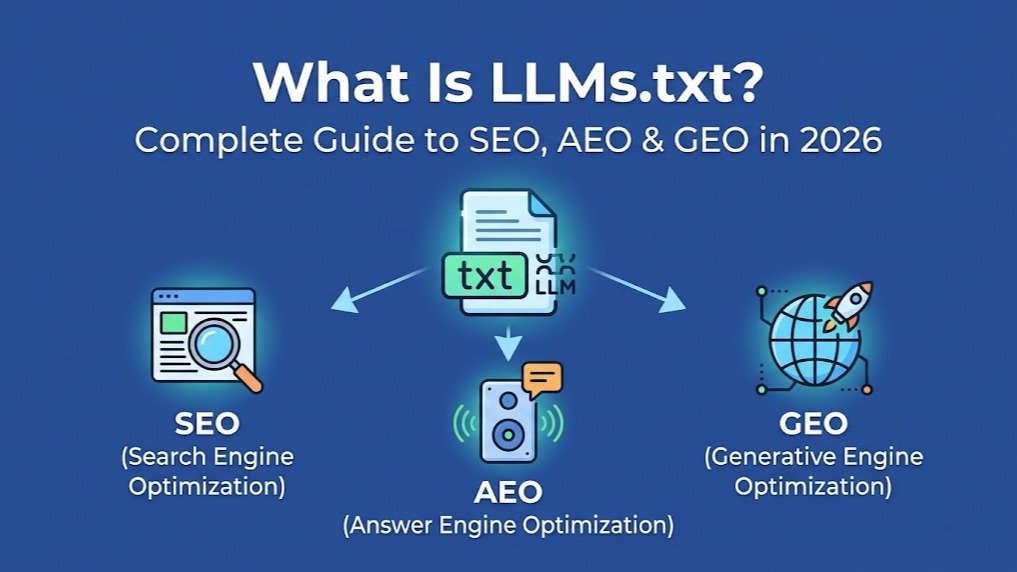
Where Does llms.txt Fit Into SEO, AEO and GEO?
This is where the subject becomes especially useful.
SEO: Search Engine Optimization
SEO focuses on improving website visibility in traditional and AI-enhanced search engines.
Core SEO areas include:
- Crawlability
- Indexability
- Keyword relevance
- Content quality
- Internal linking
- Backlinks
- Page experience
- Technical SEO
- Structured data
- Website authority
You can use the WaooTools SEO Audit Tool to review multiple areas including on-page SEO, links, usability, performance, technical factors and GEO readiness.
Google's current guidance makes an important point: traditional SEO best practices remain the foundation for visibility in generative Google Search experiences.
AEO: Answer Engine Optimization
Answer Engine Optimization focuses on making content easier for search and AI systems to understand and use when answering questions.
AEO-friendly content often includes:
- Clear definitions
- Question-based headings
- Concise answers
- FAQs
- Lists
- Tables
- Supporting evidence
- Descriptive headings
- Strong topical context
- Clear entity relationships
For example, instead of writing:
There are several things people need to understand about files used for AI.
A stronger AEO format is:
What is llms.txt?
llms.txt is a proposed Markdown file that gives compatible AI systems structured information about a website and its important resources.
The second version is easier for both people and answer systems to understand.
GEO: Generative Engine Optimization
Generative Engine Optimization (GEO) focuses on improving the chances that content can be understood, retrieved, referenced or cited in AI-generated answers.
GEO has become increasingly relevant as search platforms integrate generative AI.
Bing, for example, now provides AI Performance reporting that can show publishers when their pages are cited in AI-generated answers and which queries contributed to those citations.
Good GEO therefore goes beyond inserting keywords.
It involves creating information that is:
Clear. Specific. Useful. Verifiable. Structured. Current.
Does llms.txt Help GEO?
Potentially—but it should not be treated as a magic GEO ranking file.
The llms.txt proposal is designed to make website information easier for compatible agents to locate and understand.
But AI platforms use different retrieval systems, indexes and crawling technologies.
Not every AI system supports llms.txt.
Google explicitly states that it does not use llms.txt for Google Search visibility.
Therefore, the better strategy is:
Use llms.txt as an additional accessibility and discovery layer while continuing to strengthen your normal SEO, content quality and technical website structure.
Why Create an llms.txt File?
There are several reasonable reasons to publish one.
1. Provide a Clear Website Summary
An llms.txt file can immediately explain:
- What your website does
- Who it serves
- What information it contains
- Which pages are important
- Which resources AI agents should examine
2. Highlight Important Content
Large websites can contain thousands of URLs.
Your llms.txt file can point toward high-value pages such as:
- Documentation
- Product information
- Tools
- Research
- Guides
- API documentation
- Support resources
- Policies
3. Reduce Ambiguity
AI systems perform better when entities and relationships are clearly described.
For example:
Less clear:
“We provide useful online things.”
More useful:
“WaooTools provides browser-based SEO, website analysis, backlink, PDF and security utilities for marketers, developers, agencies and website owners.”
Specific descriptions reduce ambiguity.
4. Prepare for AI Agents
Agentic browsing is becoming more important.
Google itself now discusses website preparation for browser-based AI agents within its generative AI optimization guidance.
Providing clean website structure, accessible textual information and clear resources can therefore have benefits beyond traditional search optimization.
How WaooTools Uses llms.txt
WaooTools currently publishes its own llms.txt file.
You can view the WaooTools llms.txt file.
It organizes important areas of the platform so machines and people can identify the site's main resources.
For a tools-based website, this approach makes sense because the platform contains many different utilities across categories such as:
- SEO tools
- Backlink tools
- Website analysis tools
- PDF tools
- Security tools
- URL utilities
A central structured resource can make relationships among those tools easier to understand.
How to Optimize a Website for SEO, AEO and GEO
Creating llms.txt is only one small part of a wider strategy.
The following areas matter much more.
1. Build Strong Traditional SEO Foundations
Before worrying about AI visibility, make sure search engines can properly access and understand the website.
Check:
- Indexability
- Robots directives
- XML sitemaps
- Canonical tags
- Titles
- Meta descriptions
- Internal links
- Broken links
- Mobile usability
- Website speed
- HTTPS
- Duplicate pages
Run a complete WaooTools SEO audit to identify technical and on-page issues across your website.
Google's official generative AI guidance continues to emphasize crawlability, indexing, helpful content and strong technical structure rather than separate AI-only SEO tricks.
2. Create Unique, Expert-Led Content
Generic articles are becoming easier to produce.
That makes originality more important.
Add information competitors cannot easily reproduce:
- Original testing
- Expert experience
- Real examples
- Product data
- Research
- Case studies
- Screenshots
- Comparisons
- Statistics
- Unique workflows
- First-hand findings
Google specifically recommends creating useful, unique and non-commodity content for generative search visibility.
3. Answer Questions Directly
For AEO, place direct answers close to relevant questions.
For example:
What Is Generative Engine Optimization?
Generative Engine Optimization is the practice of improving content so it can be clearly understood, retrieved and represented within AI-generated search experiences.
Then expand the explanation.
This structure works well for humans while also making the main concept immediately identifiable.
4. Improve Internal Linking
Internal links help connect related information.
For example, an article about SEO auditing can naturally point readers toward:
- SEO Audit Tool
- Meta Tag Generator
- Internal Links Checker
- Broken Links Checker
- PageSpeed tools
Use the WaooTools Internal Links Checker to review how pages on your website connect to one another.
Good internal linking helps users discover related resources and gives search systems clearer relationships between topics.
5. Optimize Titles and Meta Descriptions
Every important page should have a unique and descriptive title.
Your main topic should normally be obvious from both the title and the page content.
You can generate page metadata with the WaooTools Meta Tag Generator.
Avoid keyword stuffing.
A title such as:
LLMs.txt Guide: SEO, AEO & GEO Best Practices
is much more natural than:
LLMs.txt SEO | LLM SEO | AI SEO | GEO SEO | AEO SEO Tool Guide
Search optimization should improve clarity, not destroy readability.
6. Cite Reliable Sources
GEO-friendly content should make important claims verifiable.
When discussing Google's search systems, reference Google.
When discussing Bing, reference Microsoft/Bing.
When discussing llms.txt, reference the specification.
Examples include:
- Google's generative AI search optimization guide
- The llms.txt specification
- Bing Webmaster AI Performance documentation
Reliable sourcing strengthens the usefulness and credibility of content.
7. Keep Information Updated
Old information can reduce usefulness.
Add:
- Published date
- Updated date
- Author information
- Clear revision history where appropriate
Review technical and AI-search articles regularly because these technologies are developing quickly.
For example, the llms.txt proposal itself was substantially updated to version 2 in August 2026.
How to Measure GEO and AI Search Visibility
GEO should not be based entirely on guesses.
Measurement options are improving.
Google Search Console
Google introduced dedicated Generative AI performance reports in Search Console in 2026 and reported that availability had expanded worldwide by August 31, 2026.
These reports can help website owners understand visibility in experiences such as AI Overviews and AI Mode.
Bing Webmaster Tools
Bing's AI Performance features provide information such as:
- AI citations
- Cited pages
- Grounding queries
- Visibility trends
- Topics
- Intent
- Citation share
This is particularly useful for GEO analysis because it moves AI search measurement beyond simply checking whether a brand appears in a manually generated answer.
Common llms.txt and AI SEO Mistakes
Treating llms.txt as a Ranking Hack
There is currently no evidence that simply publishing llms.txt will increase Google rankings.
Google specifically says the file is not required for its generative search features.
Ignoring Traditional SEO
Poor indexing cannot be fixed by llms.txt.
Weak content cannot be fixed by llms.txt.
Broken internal links cannot be fixed by llms.txt.
A website still needs solid SEO fundamentals.
Creating Thin AI Content at Scale
Publishing hundreds of near-identical articles for every possible AI-related query is not a sustainable GEO strategy.
Google recommends useful, differentiated, people-first content and warns against scaled content created mainly to manipulate search visibility.
Forgetting Internal Links
An isolated article is harder for readers to discover and provides weaker contextual connections.
Relevant articles, tools and resources should naturally link to one another.
You can also use the WaooTools Broken Links Checker to detect URLs that no longer work.
Frequently Asked Questions About llms.txt
What is llms.txt?
llms.txt is a proposed Markdown file that provides compatible AI systems and agents with a structured description of a website and links to important resources.
Where should llms.txt be placed?
The main file is normally placed at the root of a website:
https://example.com/llms.txt
The version 2 specification also supports files at subpaths where appropriate.
Is llms.txt required for SEO?
No.
Traditional search engine optimization does not require an llms.txt file.
Does Google use llms.txt?
Google currently says it does not use llms.txt as a special mechanism for Google Search or its generative AI search features.
Will llms.txt improve Google rankings?
Publishing llms.txt alone should not be expected to improve Google rankings.
Google says it neither helps nor hurts visibility in Google Search.
Is llms.txt the same as robots.txt?
No.
robots.txt provides crawler access instructions, while llms.txt is intended to describe website information and useful resources to compatible AI systems.
What is AEO?
Answer Engine Optimization (AEO) is the practice of structuring and improving content so search systems and AI-powered answer engines can clearly understand and answer users' questions.
What is GEO?
Generative Engine Optimization (GEO) refers to optimizing content and website signals for visibility within generative AI search and answer experiences.
Is GEO replacing SEO?
No.
GEO builds on many of the same foundations as SEO.
Google itself says that SEO best practices continue to be relevant to generative AI search.
What is the best strategy for AI search visibility?
Focus on:
- Strong technical SEO
- Crawlable and indexable pages
- Unique, useful content
- Clear answers
- Strong internal linking
- Reliable sources
- Accurate entity information
- Structured page organization
- Updated information
- Real expertise and original value
Then use emerging technologies such as llms.txt where they provide additional value.
Final Thoughts
llms.txt represents an interesting development in the relationship between websites and AI agents.
Its purpose is straightforward: provide AI-compatible systems with a clean description of a website and direct access to important resources.
But it should not be viewed as a replacement for SEO or as a guaranteed GEO shortcut.
The strongest strategy is broader.
Build technically accessible websites.
Publish genuinely useful information.
Answer questions clearly.
Create strong internal connections between related pages.
Reference authoritative sources.
Keep your information accurate and current.
Use traditional SEO to make your website discoverable, AEO to make your answers easy to understand, and GEO to improve how your information can participate in generative search experiences.
Then use llms.txt as another layer that helps compatible AI systems understand what your website has to offer.
As AI-powered discovery develops, the websites most likely to remain useful are not those chasing every new optimization trick.
They are the websites that make their information easy to find, easy to understand, trustworthy and genuinely worth citing.