Search engines are changing how people discover information online. Instead of browsing several websites to find an answer, users can now ask questions and receive AI-generated responses that summarize information from multiple sources.
Google AI Overviews, AI Mode, and other AI-powered search experiences are making this change more noticeable. People can ask detailed questions, compare products, explore complicated topics, and discover relevant websites through a single search experience.
For website owners, marketers, bloggers, and SEO professionals, this creates an important question: How can you optimize a website for AI search without losing focus on traditional SEO?
The good news is that you do not need to abandon your existing SEO strategy. Technical SEO, useful content, internal linking, website performance, and a clear site structure remain important.
However, you need to pay closer attention to the quality of your content, the information you provide, and how easily people and search systems can understand your website.
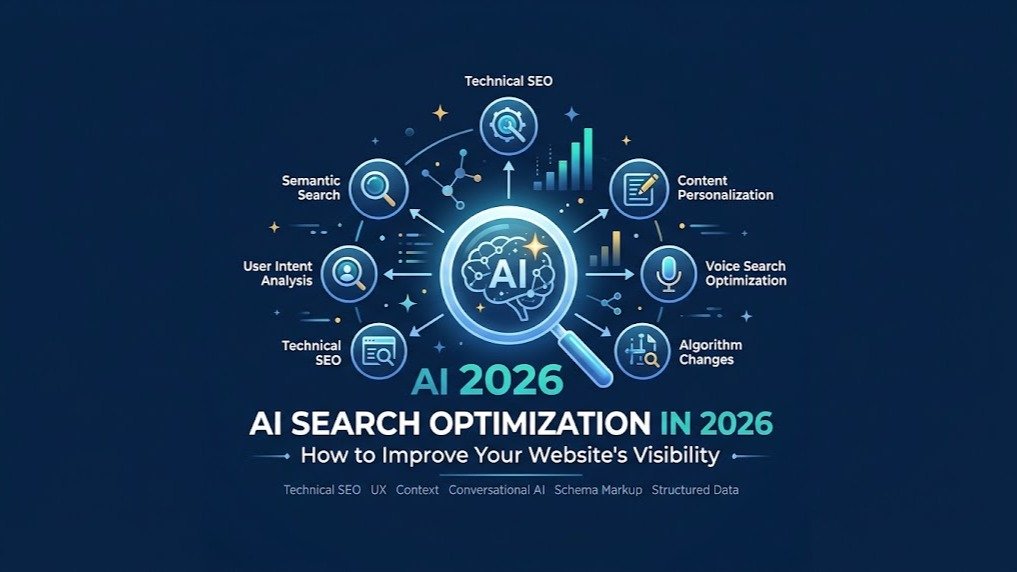
In this guide, we will explain what AI search optimization means, how it relates to traditional SEO, and which practical steps can help improve your website's visibility in 2026.
What Is AI Search Optimization?
AI search optimization is the process of improving a website's content, structure, and technical accessibility so that search systems powered by artificial intelligence can understand its information and potentially surface its pages in relevant results.
Traditional search engines often present a list of links that users can visit to find information. AI-powered search experiences can also generate summaries, answer questions, compare options, and provide links to supporting websites.
For example, someone searching for ways to improve website speed might receive an AI-generated explanation covering image optimization, caching, JavaScript, and server response time.
The response may include links to websites that provide relevant information or additional details.
If you publish a useful guide about website performance, your page could be a relevant resource for people exploring that topic. However, appearing in an AI-generated response is not guaranteed, even when your content follows SEO best practices.
AI search optimization is therefore not about finding a secret formula to make AI recommend your website. It is about creating valuable, accessible, well-organized content that deserves to be discovered.
How Is AI Search Different From Traditional Search?
Traditional search commonly displays organic listings, paid advertisements, and other search features. Users choose a result and visit the corresponding website.
AI-powered search can combine information from different sources into a generated response. Depending on the platform and query, users may also receive citations, supporting links, suggested follow-up questions, and additional ways to explore a topic.
Here is a simple comparison:
| Traditional SEO | AI Search Optimization |
|---|---|
| Focuses on visibility in search engine results | Also considers visibility within AI-generated search experiences |
| Targets relevant search queries and user intent | Addresses questions, comparisons, and more complex information needs |
| Uses useful content and technical optimization | Relies on the same foundations while emphasizing clear, useful information |
| Measures rankings, impressions, clicks, and conversions | Can also involve measuring AI citations or visibility where reporting is available |
| Helps search engines discover and understand pages | Helps maintain accessible, relevant content that may be surfaced in AI experiences |
These approaches are closely connected. Google explains in its official guide to AI features and your website that established SEO best practices remain relevant to AI Overviews and AI Mode.
This means businesses should continue investing in good SEO rather than treating AI search as an entirely separate discipline.
Why AI Search Optimization Matters in 2026
People use search engines to do more than find individual webpages. They want recommendations, explanations, comparisons, solutions, and information that helps them make decisions.
AI-powered search experiences can address these needs by combining information and providing links for further research.
For website owners, this creates both opportunities and challenges.
1. Search Visibility Is About More Than Rankings
Ranking on the first page of Google remains valuable, but the search experience can include AI-generated responses and other features above or alongside traditional organic listings.
This means you should understand how your website appears across different search experiences.
A page may attract impressions without receiving as many clicks as expected. In other cases, an AI-generated response may provide another opportunity for users to discover your content.
Do not assume that every change in organic traffic is caused by AI. Seasonality, competitors, algorithm changes, search demand, and technical problems can also affect performance.
Review your search data before deciding which changes your website needs.
2. Helpful Content Has a Clear Purpose
AI systems can generate basic explanations quickly, making generic content less useful as a reason for someone to visit a particular website.
Imagine two articles about website speed.
The first simply lists common recommendations such as compressing images, enabling caching, and reducing JavaScript.
The second explains how to identify the largest performance bottlenecks, interpret testing results, prioritize fixes, and verify whether those changes actually improve the experience.
The second article gives readers more practical value.
Whenever possible, include original testing, meaningful examples, screenshots, expert insights, or findings that cannot be obtained simply by rewriting existing articles.
Google's guidance on optimizing websites for generative AI search specifically emphasizes valuable, unique content rather than pages that merely repeat information already available elsewhere.
3. Businesses Need to Build Trust
Users need reliable information, especially when researching products, services, technical problems, or important decisions.
A website should make it clear who publishes its content, what the information covers, and where important claims come from.
For example, an article explaining Google's indexing process should reference relevant Google documentation rather than relying entirely on assumptions.
Similarly, a product comparison should explain the basis of its recommendations instead of presenting unsupported claims.
Trust is not created by adding a few authoritative links to an otherwise weak article. It comes from accuracy, transparency, useful information, and consistency across the website.
How to Optimize Your Website for AI Search
You do not need to rebuild your entire website to prepare for AI-powered search experiences.
Start with the fundamentals, identify weaknesses, and improve the pages that matter most to your audience.
1. Start With a Technical SEO Audit
Before focusing on AI visibility, make sure search engines can access and understand your important pages.
Technical problems can prevent useful content from being discovered or indexed correctly.
Review the following areas:
-
Indexability: Check whether important pages can appear in search results.
-
Robots.txt: Make sure crawler instructions are not blocking content you want indexed.
-
XML sitemap: Keep your sitemap accurate and include relevant, indexable URLs.
-
Canonical tags: Use appropriate canonical URLs to help search engines understand preferred versions of pages.
-
Internal links: Ensure important pages are connected to other relevant pages on your website.
-
HTTP status codes: Investigate unexpected errors and redirect problems.
-
Mobile usability: Make sure the website works well on smaller screens.
-
Page performance: Identify slow loading times and unnecessary resources.
You can begin with the WaooTools SEO Audit Tool to review website SEO and technical issues.
For authoritative guidance, consult Google's SEO Starter Guide and Search Essentials.
Remember that an audit is a starting point, not a guarantee of rankings. Review the findings and prioritize problems according to their actual impact.
2. Write Content That Directly Answers Search Intent
One of the most effective ways to improve content is to understand what readers actually want to accomplish.
Consider the difference between these searches:
-
What is website speed?
-
How do I test website speed?
-
Why is my website slow on mobile?
-
How can I improve Core Web Vitals?
-
Which website speed testing tool should I use?
Although these searches concern the same general subject, each represents a different need.
Someone asking what website speed means needs an explanation. Someone trying to fix a slow mobile website needs diagnostic steps and possible solutions.
Your content should address the specific problem rather than forcing every visitor through the same generic introduction.
A useful structure is:
-
Introduce the problem.
-
Give a clear explanation or direct answer.
-
Explain the process step by step.
-
Provide examples where they help.
-
Discuss common mistakes.
-
Link to relevant tools and authoritative documentation.
-
Explain what the reader should do next.
This structure helps readers find information without having to work through unnecessary paragraphs.
It also makes your content easier to navigate.
However, avoid creating dozens of nearly identical articles for minor keyword variations. Each article should serve a distinct purpose and provide meaningful value.
3. Use Clear Headings and Logical Content Structure
Headings help readers understand the organization of an article.
They also make it easier to navigate long pages and locate relevant sections.
Use one clear H1 heading for the main topic, followed by H2 headings for major sections and H3 headings for related subtopics where appropriate.
For example, a guide about website SEO could use this structure:
-
H1: How to Improve Website SEO
-
H2: What Is Website SEO?
-
H2: How to Find SEO Problems
-
H3: Check Page Titles and Meta Descriptions
-
H3: Review Internal Links
-
H3: Identify Technical Errors
-
H2: How to Monitor SEO Performance
Keep headings descriptive and natural.
You do not need to insert your target keyword into every heading. Use relevant wording where it helps explain the section.
Avoid unnecessary formatting tricks designed solely to influence AI systems. Clear organization is useful because it helps people understand the content, not because a particular heading pattern guarantees AI visibility.
4. Focus on Original Information Instead of Generic Articles
Publishing more articles does not automatically mean your website will receive more organic traffic.
If your content repeats the same explanations found on hundreds of other websites, readers have little reason to choose your page.
Instead, look for ways to add something useful.
For a technical article, this might mean testing a tool and documenting the results.
For a comparison article, it could mean explaining the evaluation criteria and showing meaningful differences between products.
For an SEO tutorial, you could include screenshots, examples of common errors, and instructions for verifying that a fix worked.
For a business website, original customer questions and real industry experience can make content more relevant.
Before publishing an article, ask yourself:
-
Does this article answer the reader's question completely?
-
Is there useful information that competitors have overlooked?
-
Are factual claims supported by reliable sources?
-
Have I included examples where they would help?
-
Can readers take a practical next step after reading?
-
Is the content accurate and current?
If the article does not provide much value beyond a basic summary, improve it before publishing.
5. Improve Internal Linking Across Your Website
Internal linking is important for traditional SEO and remains a valuable part of a well-organized website.
An internal link connects one page on your website to another page on the same website.
For example, a blog post about technical SEO might link to a guide about broken links, a page speed article, and a relevant website analysis tool.
These links help readers explore related information without having to return to the homepage or search for another article.
They also help search engines discover pages and understand relationships between content.
For WaooTools, internal links can connect informational blog posts to relevant tools.
For example:
-
An article about website audits can link to the SEO Audit Tool.
-
A guide about broken links can link to the Broken Links Checker.
-
An article about page performance can link to the Page Speed Checker.
-
A tutorial about website metadata can link to the Meta Tag Generator.
Use descriptive anchor text that tells readers what they can expect after clicking.
Instead of repeatedly using generic phrases such as "click here," describe the destination naturally.
You can also use the WaooTools Internal Links Checker to help review internal links on a webpage.
The goal is not to insert as many links as possible. Each link should help the reader or provide relevant context.
6. Improve Website Speed and User Experience
A website may contain excellent content but still frustrate visitors if it loads slowly or behaves poorly on mobile devices.
Performance improvements can make pages easier to use and help visitors reach the information they need.
Start by testing important pages rather than relying on a single homepage speed score.
Pay attention to:
Image optimization: Resize images appropriately and use efficient formats where suitable.
JavaScript: Remove unnecessary scripts and reduce work that delays page rendering or interaction.
CSS: Reduce unnecessary styles and investigate render-blocking resources.
Caching: Configure appropriate caching to avoid repeatedly downloading resources that do not change frequently.
Server response: Investigate slow responses from the hosting environment, database, or application.
Third-party scripts: Review analytics, advertising, chat widgets, and other external scripts that may affect performance.
Use the WaooTools website tools for initial checks, and consult Google PageSpeed Insights for detailed performance diagnostics.
Google's web.dev performance documentation is another useful resource for understanding Core Web Vitals and related optimization techniques.
Do not focus exclusively on achieving a perfect score. Look for improvements that make the actual page faster, more stable, and easier to use.
7. Use Structured Data Correctly
Structured data provides additional information about a webpage in a format that supported search systems can process.
Depending on the content, relevant structured data types may include Article, BreadcrumbList, Organization, Product, or other supported types.
For example, Article structured data can help describe an article's headline, author, publication date, and other relevant properties.
However, structured data must accurately represent the content visible on the page.
Do not add irrelevant schema types simply because you think they might improve AI visibility.
Google explains that special AI-specific structured data is not required for inclusion in AI Overviews or AI Mode. Standard SEO practices and eligibility requirements remain important.
You can review Google's structured data documentation to understand the available options.
The purpose of structured data is to describe your content accurately, not to guarantee rankings or citations.
8. Build Credibility With Reliable External References
External links connect your content to information hosted on other websites.
When used appropriately, they can help readers verify claims, explore official documentation, and learn more about a subject.
For example, an article about AI search optimization can reference Google's official search documentation.
A technical guide about website performance can link to web.dev.
An article about search performance measurement can explain how Google Search Console reports impressions, clicks, and other metrics.
Choose sources based on relevance and reliability.
Official documentation is often the best starting point for explaining how a specific product or platform works.
Avoid adding external links simply to make an article look authoritative. Every reference should serve a purpose.
Also, remember that linking to an authoritative website does not automatically improve your rankings. The main benefit is providing readers with useful supporting information.
9. Measure AI Search and Organic Search Performance
SEO improvements should be evaluated using actual data rather than assumptions.
Google Search Console can help you monitor how your website performs in Google Search.
Review metrics such as:
-
Organic clicks
-
Search impressions
-
Click-through rate
-
Average position
-
Search queries
-
Landing pages
-
Changes in performance over time
Compare relevant date ranges and investigate pages experiencing significant changes.
For example, if impressions remain stable while clicks decline, examine the queries involved and how the search results have changed. Do not immediately assume AI Overviews caused the decline.
Google includes traffic from its AI search features in the overall Web search performance reporting. Google may also provide additional AI-related reporting features as they become available.
You can access Google Search Console to monitor your website's search performance.
For other AI search platforms, use their available reporting tools when they provide meaningful information about citations or website visibility.
Track business outcomes as well. A page that attracts fewer visitors but generates relevant leads or sales may be more valuable than a page receiving large amounts of unqualified traffic.
AI SEO Mistakes to Avoid in 2026
As AI search becomes more prominent, website owners may be tempted to follow every new optimization technique they encounter.
Not every recommendation is supported by reliable evidence.
Here are some mistakes worth avoiding.
Mistake 1: Treating AI SEO as a Replacement for Traditional SEO
Your website still needs accessible pages, useful content, appropriate internal links, and a sound technical foundation.
Ignoring these areas to focus entirely on AI-specific tactics can create unnecessary problems.
Mistake 2: Publishing Large Volumes of Generic AI Content
AI can help with research, outlining, editing, and drafting. However, producing large numbers of similar articles without adding value can lead to low-quality content.
Review every article for originality, accuracy, usefulness, and relevance before publishing.
Mistake 3: Stuffing Keywords Into Every Heading
Repeating the same keyword excessively does not make an article more helpful.
Use the primary keyword naturally and include related terms when they accurately describe the topic.
Write for the reader first.
Mistake 4: Believing Every AI Optimization Trick
Be cautious of services promising guaranteed AI citations, guaranteed rankings, or secret access to search algorithms.
No legitimate third-party tool can guarantee that Google will cite your website in an AI-generated response.
Focus on techniques that improve content quality, technical accessibility, usability, and measurement.
Mistake 5: Ignoring Existing Content
You do not always need to publish another article to improve organic traffic.
Sometimes, updating an existing page is the better option.
Review older content for outdated information, broken links, missing explanations, inaccurate claims, and opportunities to add original examples.
Update the page when the changes genuinely improve its usefulness.
A Practical AI Search Optimization Checklist
Use this checklist when reviewing your website or preparing a new article.
| Task | What to Check |
|---|---|
| Technical SEO | Important pages are accessible and indexable |
| Content quality | The article answers a real user need |
| Originality | The page adds useful information beyond generic summaries |
| Search intent | The content matches what the reader wants to accomplish |
| Headings | Sections are logically organized and descriptive |
| Internal linking | Relevant pages connect to one another |
| External references | Important claims have appropriate supporting sources |
| Website performance | Pages load and work well across devices |
| Structured data | Markup is accurate and relevant |
| Search monitoring | Search Console data is reviewed regularly |
| Content maintenance | Outdated information and broken links are addressed |
You can use this checklist as part of your regular SEO workflow.
For a broader technical review, start with a website audit and then investigate the findings that matter most to your site.
Remember that completing every item does not guarantee rankings or AI citations. These practices help establish a solid foundation for a useful and accessible website.
The Future of SEO: What Website Owners Should Focus On
AI-powered search will continue to evolve, and the way users discover websites may change as new features become available.
However, the fundamentals of a useful website are unlikely to become irrelevant simply because search technology changes.
People still need accurate information, practical solutions, trustworthy sources, and websites that are easy to use.
Businesses should therefore avoid rebuilding their SEO strategy around every new acronym or prediction.
Instead, focus on understanding your audience, creating original content, maintaining a strong technical foundation, and measuring the results of your work.
For smaller websites, this may mean improving the most important pages before expanding the content library.
For established businesses, it could mean reviewing technical SEO, updating outdated resources, improving internal links, and identifying gaps in existing content.
For publishers, it may involve investing more time in original research, practical examples, and content that reflects genuine expertise.
The best strategy depends on your website, audience, and business goals.
Final Thoughts
AI search optimization is an important part of the changing search landscape in 2026, but it does not require abandoning traditional SEO.
A strong strategy starts with accessible pages, useful content, relevant internal links, reliable references, and a website that works well for visitors.
From there, focus on answering questions clearly, adding original information, maintaining technical quality, and monitoring performance.
Avoid shortcuts that promise guaranteed rankings or AI citations. Instead, build a website that gives people a genuine reason to visit and return.
If you want to start improving your website today, explore the available tools on WaooTools to review technical SEO, website links, metadata, and page performance.
Use the results to identify real problems, make meaningful improvements, and continue measuring what works.
Good SEO is not about optimizing for every new search trend. It is about making your website more useful, accessible, and relevant to the people you want to reach.