Publishing good content is only part of building a successful website.
Search engines, visitors, and AI-powered discovery systems also need to understand how your pages relate to each other.
That is where internal linking becomes important.
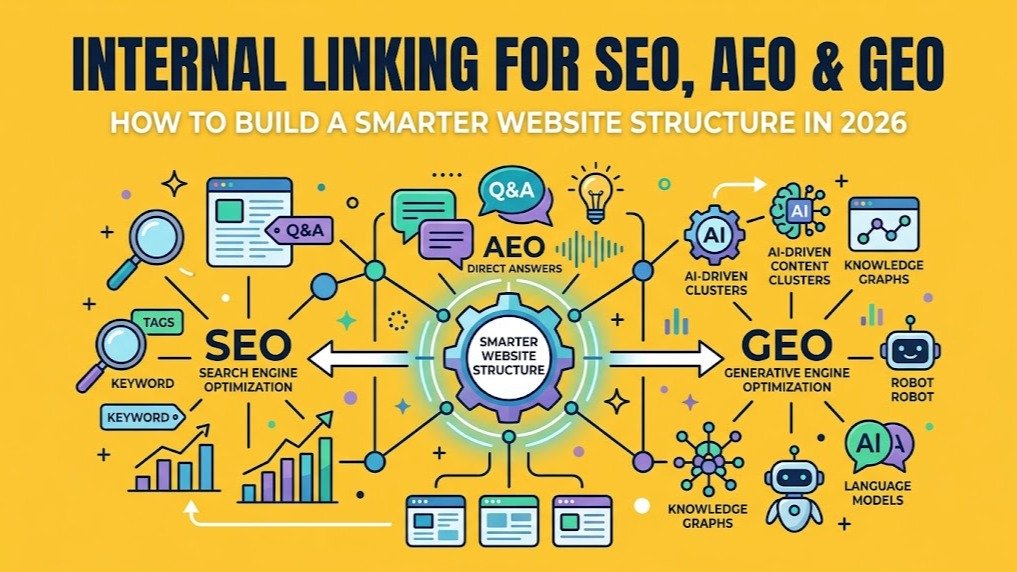
An effective internal linking strategy can help search engines discover pages, give users clearer navigation, establish relationships between related topics, and strengthen the overall structure of your website.
As search expands beyond traditional blue links into AI Overviews, AI Mode, Copilot, answer engines, and generative search experiences, website structure and content relationships are becoming even more important.
This guide explains how to use internal linking for SEO, AEO and GEO, how anchor text should be written, which pages should receive internal links, and how to avoid common linking mistakes.
What Is Internal Linking?
An internal link is a hyperlink from one page of your website to another page on the same domain.
For example, a blog post about technical SEO might link to an SEO audit tool, a broken links checker, or a page speed checker on the same website.
The purpose is not simply to add links.
Internal links create relationships between pages.
They help visitors continue exploring a topic and can help search engines discover and understand the structure of a website.
Google specifically states that it uses links to discover new pages and as a signal when determining page relevance. Google also recommends that important pages should generally have at least one link from another page on the website.
Why Are Internal Links Important for SEO?
Internal linking helps traditional SEO in several ways.
The first is page discovery.
If you publish a new article but nothing on your website links to it, search engines may have fewer pathways through which to discover the page.
A relevant internal link creates another route.
The second benefit is context.
Imagine that you have several pages covering SEO audits, backlinks, page speed, meta tags, and technical SEO.
When those pages naturally reference one another, they form a connected topic cluster rather than operating as isolated pages.
The third benefit is usability.
Someone reading a guide about an SEO problem may want to move directly to a relevant tool or a more detailed article.
For example, a website owner reading about link structure can use the WaooTools Internal Links Checker to review links found on a page. WaooTools Internal Links Checker
Internal Linking and AEO
Answer Engine Optimization, or AEO, focuses on making information easy to understand and useful when search engines or AI systems answer questions.
Internal links can support that objective by connecting an answer with deeper supporting information.
Suppose an article answers:
What is a broken link?
The article can provide a short direct answer and then point readers toward a detailed guide or a broken links checking tool.
This creates a layered information structure.
The first page answers the question immediately.
The linked page provides deeper information or allows the user to take action.
That approach can improve the experience for both users who want quick answers and visitors who need more detail.
It is important, however, not to treat internal links as an AEO trick. The quality, clarity and usefulness of the actual content remain more important.
Internal Linking and GEO
Generative Engine Optimization, or GEO, focuses on improving how content can participate in AI-generated search and answer experiences.
Internal linking alone does not guarantee AI citations.
However, a well-organized website can make relationships between topics clearer.
Google's current guidance for generative AI search continues to emphasize traditional SEO fundamentals, including crawlability, clear technical structure, useful content and well-organized pages. Google specifically says SEO best practices remain foundational for visibility in its generative AI search experiences.
Microsoft has also expanded Bing Webmaster Tools with AI Performance reporting that shows citations, cited pages, grounding queries, intents, topics and citation share across supported AI experiences. This illustrates how AI visibility is increasingly connected to pages, topics and query context rather than a single traditional keyword ranking.
For GEO, internal linking should therefore be viewed as part of a wider content architecture strategy.
Build Topic Clusters Instead of Isolated Pages
One of the most useful internal linking approaches is the topic cluster.
A topic cluster contains one broad page and several more specific related pages.
For example, a broad SEO hub might connect to articles covering technical SEO, backlinks, website speed, internal links, meta tags, XML sitemaps and indexing.
Those supporting pages can also link back to the broader hub where appropriate.
This creates a logical relationship between the pages.
For WaooTools, a blog article about website optimization can naturally point users toward the WaooTools SEO Audit Tool, which reviews areas including on-page SEO, GEO, links, usability, performance and technical factors. Run a WaooTools SEO Audit
The objective is not to create a complicated network of links.
The objective is to make it obvious which content belongs together.
Use Descriptive Anchor Text
Anchor text is the clickable text used in a hyperlink.
Compare these two examples.
Weak anchor:
Click here.
Better anchor:
Check your website's internal links.
The second example tells the reader what they can expect after clicking.
Google recommends anchor text that is descriptive, reasonably concise and relevant to both the page containing the link and the destination page.
Avoid forcing exact-match SEO keywords into every internal link.
A natural website might use several variations depending on context.
For example, links to the same tool might naturally say “check internal links,” “review your internal linking structure,” or “use the internal links checker.”
The text should make sense to the reader first.
Link From Relevant Content
Relevance matters more than simply adding large numbers of links.
A blog post about page speed can reasonably link to a Page Speed Checker.
A blog about broken URLs can link to a Broken Links Checker.
A guide explaining metadata can link to a Meta Tag Generator.
Those relationships make sense.
WaooTools already provides dedicated tools that can support these content relationships, including its Page Speed Checker WaooTools Page Speed Checker, Broken Links Checker WaooTools Broken Links Checker and Meta Tag Generator. WaooTools Meta Tag Generator
A password generator linked from an article about meta descriptions, by contrast, would probably not improve the reader's journey.
Internal links should exist because there is a logical connection.
Give Important Pages More Internal Visibility
Not every page on a website has the same business value.
Some pages are strategically important.
These might include major service pages, product pages, popular tools, category pages, conversion pages, research, cornerstone guides or important landing pages.
Those pages should not be hidden deep within the website.
If an important page can only be reached after five or six unrelated clicks, its position in the site's architecture may need improvement.
Look for relevant opportunities to link toward your strongest pages from related content.
For example, several SEO articles on WaooTools can naturally point users toward the main SEO Audit Tool when a complete analysis is relevant.
This gives readers a logical next action while strengthening connections between informational and utility content.
Fix Orphan Pages
An orphan page is a page that has no meaningful internal links pointing toward it.
The page may technically exist and even appear in a sitemap, but users may have difficulty discovering it naturally through the website.
For SEO purposes, important pages should normally participate in the site's navigation or internal linking structure.
Google's link guidance recommends making sure pages you care about receive links from other pages on your site.
During an internal linking audit, identify important pages receiving little or no internal visibility and find relevant content from which they can be linked.
Do not randomly insert them into unrelated articles simply to create a link.
Context should always come first.
Check Broken Internal Links
Internal linking only works when the destination works.
Websites naturally change over time.
Pages are renamed.
URLs are changed.
Articles are deleted.
Categories are reorganized.
Website migrations take place.
When an old link continues pointing toward a missing URL, users may encounter a 404 or another error.
You can use the WaooTools Broken Links Checker to identify unavailable or problematic links on a webpage. Check Broken Links with WaooTools
WaooTools also publishes a detailed guide explaining how to find and fix broken links, including internal and external links. How to Check and Fix Broken Links on Your Website
When a broken internal link is discovered, update it to the correct destination, remove it if it is no longer useful, or implement an appropriate redirect where necessary.
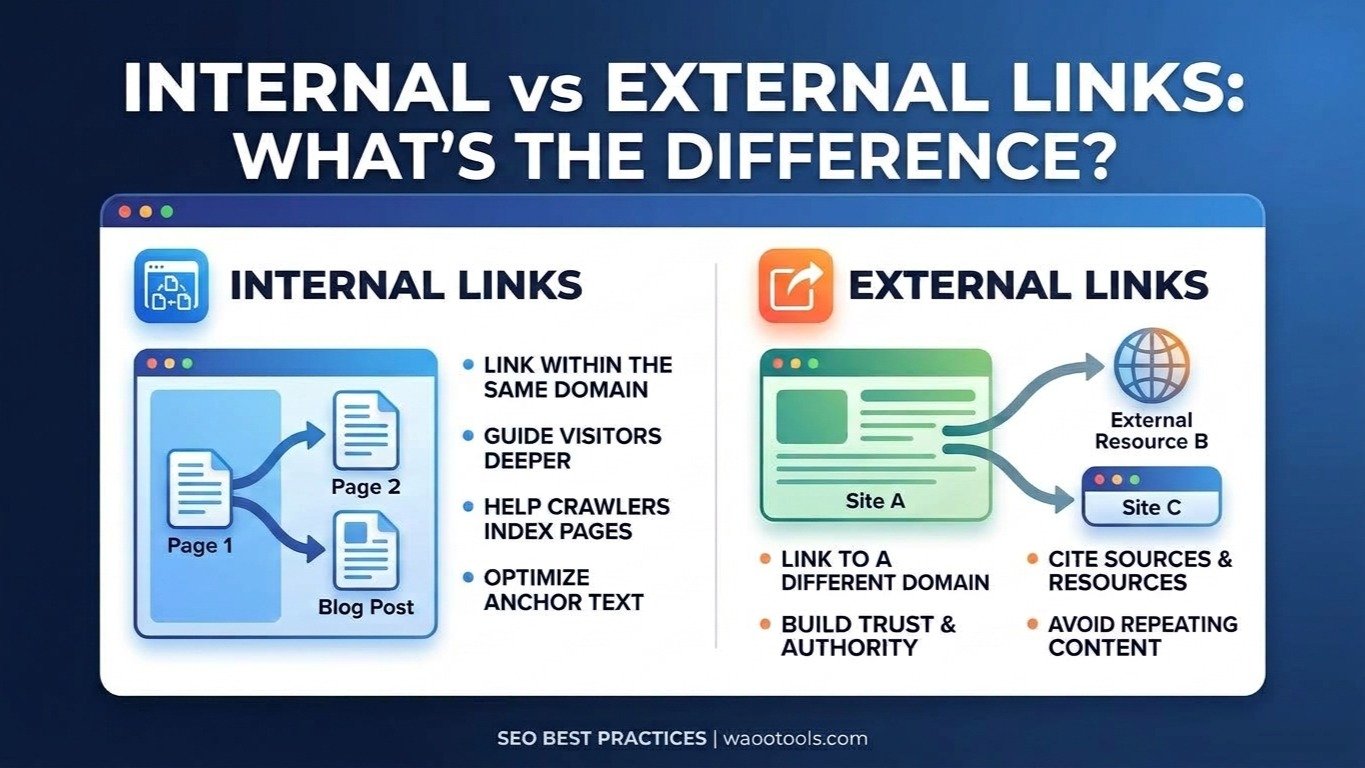
Internal Links vs External Links
Internal and external links perform different jobs.
An internal link points to another page on your own domain.
An external link points to another website.
Strong content can use both.
Internal links help users explore your website.
External links can support claims and send readers to authoritative original sources.
For example, an SEO article discussing Google's recommendations should ideally reference Google's own Search Central documentation rather than relying only on second-hand interpretations.
Google itself says linking to external sites can be useful when it provides context or supports claims with trustworthy sources.
WaooTools provides a detailed explanation of the differences between these link types in its internal versus external links guide. Internal vs External Links: What's the Difference?
Avoid Internal Linking Spam
More internal links do not automatically mean stronger SEO.
Adding the same destination dozens of times to one page can reduce readability.
Likewise, adding keyword-heavy anchors simply to target search terms can make content feel unnatural.
Google says there is no magical ideal number of links for a page and recommends linking naturally rather than stuffing keywords into anchor text.
A useful rule is simple:
Add a link when it helps the reader understand the topic, verify information or take the next logical action.
If the link exists only because you want another SEO signal, reconsider whether it belongs there.
Internal Linking for AI Search Visibility
AI-powered search does not eliminate traditional website architecture.
Google's generative AI search documentation explains that pages still need to be discoverable, crawlable and indexable, and that conventional SEO best practices continue to matter.
Therefore, optimizing for AI search should not mean abandoning normal SEO practices.
Instead, create a site where important information is easy to discover and relationships between topics are clear.
A page defining domain authority might link to a domain authority checker.
An article explaining backlinks might link to a backlink checker.
A technical SEO guide might connect to the SEO audit tool, internal link checker and page speed checker.
This creates meaningful pathways through the website.
How to Audit Your Internal Linking Structure
Start with your most important pages.
Check which pages link to them and whether those links come from relevant content.
Then inspect newer blog posts, older guides, category pages and high-traffic articles for opportunities to connect related resources.
Review anchor text and remove vague wording where a clearer description would benefit the reader.
Check for broken links.
Identify orphan pages.
Look for important pages that are unnecessarily buried.
Finally, run a broader website audit to understand how your internal links fit alongside indexing, metadata, performance, GEO and technical SEO.
WaooTools' full SEO Audit Tool performs a site crawl rather than checking only a homepage and includes link-related analysis within its broader report.
Frequently Asked Questions
What is an internal link in SEO?
An internal link is a hyperlink that connects one page of a website to another page on the same domain. Internal links help visitors navigate related content and can help search engines discover and understand website pages.
Do internal links improve SEO?
Internal links can support SEO by helping search engines discover pages, providing context through relevant anchor text, and creating clearer relationships between related content. They should be used naturally rather than added solely to manipulate rankings.
How many internal links should a page have?
There is no universal ideal number. Google says there is no magical number of links that every page should contain. The appropriate number depends on the content and what is genuinely useful for readers.
What is the best anchor text for internal links?
Use concise, descriptive anchor text that explains the destination. Avoid vague text such as “click here” when a clearer description is available, and avoid repeatedly stuffing exact keywords into every anchor.
Are internal links useful for AEO?
They can support AEO by connecting direct answers with deeper related information, tools and supporting resources. The usefulness and clarity of the content itself remain more important than simply increasing the number of links.
Can internal links improve GEO?
Internal linking alone cannot guarantee citations in AI-generated answers. However, logical site architecture, clear topic relationships, crawlability and useful content are compatible with the broader SEO foundations Google recommends for generative search visibility.
Should every blog post contain internal links?
When useful related content exists, internal links are usually valuable. They should be added because they help readers continue their journey, not because every article must reach a predetermined link count.
Final Thoughts
Internal linking is one of the simplest website optimization techniques, but it should be approached strategically.
Do not think of internal links as isolated SEO signals.
Think of them as connections.
They connect users with useful information.
They connect related topics.
They connect informational content with tools and solutions.
They help search engines discover pages and understand relationships within a website.
And as search evolves toward AI-powered answers and generative experiences, having a website with clear content relationships remains valuable.
Build your internal linking strategy around relevance, descriptive anchor text, useful topic clusters, working URLs and a clear visitor journey.
Combine that structure with strong SEO, direct and useful answers for AEO, and trustworthy, well-organized content for GEO.
The goal is not to create more links.
The goal is to create a website that is easier for both people and search systems to understand.